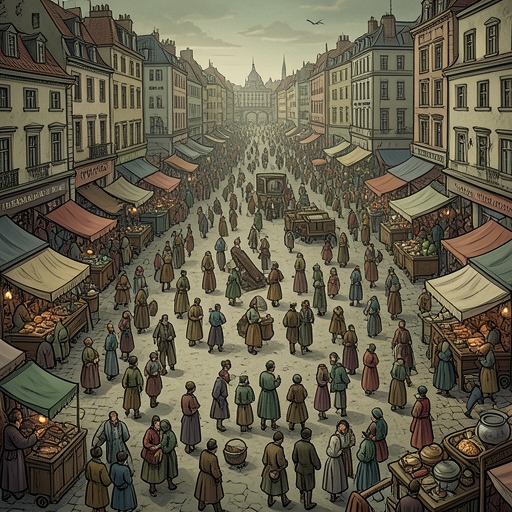
Court of Miracles settlement
The Hunchback of Notre DameThe Court of Miracles settlement enters the narrative less as a mapped neighborhood than as a collective presence: a community of thieves, vagabonds, Egyptians, and other outcasts who can assemble in striking numbers and according to recognizable ranks. Its procession to Grève Square turns people usually treated as the city’s refuse into a public spectacle, while the later anxiety over Esmeralda’s disappearance shows that the group’s ties extend beyond performance to shared concern.
Collective Identity and Public Display
The procession that reaches Grève Square has grown along its route from the Palais de Justice, recruiting knaves, idle thieves, and unemployed vagabonds. Its components arrive in an elaborate order. Egypt leads, with the Duke of Egypt on horseback and his counts walking beside him to hold his bridle and stirrups; men, women, and children follow in rags. Next comes the Kingdom of Argot, whose thieves are arranged by rank, from lesser figures to experienced pickpockets. The procession’s many trades and conditions include beggars, vagabonds, sham soldiers, and people with visible impairments, gathered under the insignia of their different grades.
The hierarchy is made both conspicuous and comic. The King of Argot, also called the grand coësre, is difficult to distinguish among the experienced pickpockets and rides crouched in a little cart drawn by two large dogs. Behind the Kingdom of Argot comes the Empire of Galilee, led by Guillaume Rousseau in a wine-stained purple robe and accompanied by buffoons, macebearers, pickpockets, and clerks. Law clerks bring up the rear with flower-crowned maypoles, black robes, music, and yellow-wax candles. At the center of the procession, officers of the Brotherhood of Fools carry a candle-laden litter bearing Quasimodo, the bellringer of Notre-Dame, as the new Pope of the Fools. Rank, costume, and ritual make the community legible to the city on its own terms, even as the spectacle invites ridicule.
Egyptians and the City’s Suspicion
The Egyptians associated with this wider world are also shown through the hostile stories told about them. Mahiette recalls a band arriving at Reims from lower Egypt by way of Poland, led by a duke and counts. The townspeople reportedly barred them from entering, after which they camped outside the Gate of Braine. According to the account, the Pope had imposed seven years of wandering without beds as penance, and the travelers told fortunes while claiming authority to collect money from senior churchmen. Their appearance and practices drew crowds, even as rumors accused them of stealing children, cutting purses, and eating human flesh.
The narrative distinguishes such rumors from established fact: townspeople warn one another away, then visit the camp secretly, and the fortune-telling fascinates mothers. Paquette la Chantefleurie takes her infant Agnes to the Egyptian women, who admire and kiss the child and praise her feet and shoes. Paquette leaves delighted by predictions of beauty, virtue, and future royalty; the next day, she steps away while the child sleeps, and returns to find the door wider open. Later, when the recluse sees a scene at the pillory, she cries out against an Egyptian as a child-stealer. Her accusation carries the force of her grief, but it also shows how the circulating stereotype supplies language for fear and blame. These episodes illuminate the prejudice surrounding the Egyptians; they do not establish the rumors as objective descriptions of the community.
A Community Bound by Concern
The settlement’s collective life is not confined to the public procession. A month after Esmeralda disappears, Pierre Gringoire and the entire Court of Miracles are described as suffering acute anxiety. The Duke of Egypt and his vagabond friends are distressed, and the goat’s disappearance deepens Gringoire’s own sorrow. Searches have yielded nothing. Bootblacks tell him that they saw Esmeralda near Saint-Michel Bridge leaving with an officer, but Gringoire trusts her chastity, which he associates with her amulet, and does not believe she has willingly abandoned it.
His confidence does not resolve the group’s concern: Esmeralda has given no sign of life, and her disappearance remains unexplained. The contrast matters. The procession presents the outcasts as a multitude arranged for public display; the search for Esmeralda reveals a community capable of attachment and sustained worry. The Court of Miracles settlement is therefore defined not only by its theatrical ranks and the city’s suspicion of its members, but also by the ties that make one person’s disappearance a shared distress.
Narrative Significance
The settlement’s appearances set an alternative social order against the institutions and respectable crowds of Paris. In the procession, titles, offices, ranks, insignia, and ceremonial objects parody the forms of authority while giving the outcasts a visible structure of their own. Yet that public organization does not protect them from the wider city’s prejudice: the stories about the Egyptians show how fascination and exclusion can operate side by side.
The narrative also gives the collective a human scale through its response to Esmeralda’s absence. The group that first commands attention as spectacle becomes a circle of companions waiting and searching. That movement from pageantry to anxiety complicates the city’s reduction of the outcasts to criminals or curiosities, without erasing the threatening rumors through which they are viewed.